Showing posts with label laura. Show all posts

Thursday, March 14, 2013

William S Manley & Mary Ann Lovell

William Manley, my 4th great grandfather and father of William Henry Manley, was born about 1825 in Belfast, Maine and moved to Sandwich, Massachusetts before he was 23.  It was there that he met and married Mary Ann Lovell born April 15, 1832 in that town.  Their marriage date was April 11, 1848.  She was 16.  By 1850 they had a child named Mary who was one year old.  By 1860 they had added William H., Almon, and Flora.  In 1870 they had moved to nearby Wareham, Mass and had added 3 more children, Laura, Reuben, and Florence.

William served in the 40th Massachusetts infantry during the civil war.  He was a private and worked as a machinist during the war (and after being discharged).  He enlisted June 8 1862 joining company I.  He was discharged June 16 1865 in Richman,VA.  

William was wounded March 1, 1864 near Cedar Run, VA.

William died about 1894 and Mary lived until May 30 1915.  She lived with Reuben in Wareham for most of the time after William died, and outlived all but one of her 8 children.

Here is a history of the 40th Massachusetts infantry:

Regimental History
FORTIETH REGIMENT
MASSACHUSETTS VOLUNTEER INFANTRY
THREE YEARS

The 40th Regt. Mass. Vol. Inf. was recruited at Camp Edwin
M. Stanton, Lynnfield, in August, 1862, Lieut. Col. Joseph A.
Dalton being in command during the recruiting period. The 
companies were mustered in on various dates from August 22 to
September 5. Major Burr Porter, U. S. A., who had won 
distinction while serving on the staff of Gen. John C. Fremont,
was commissioned colonel, but did not join the regiment until
after its arrival in Washington, Sept. 11, 1862. Here the 40th
occupied Fort Ethan Allen near Chain Bridge, and during the 
fall and winter did guard and picket duty near Miner's Hill, 
Mills' Cross Roads, and Hunter's Chapel. During this period it
was attached to Cowdin's (2d) Brigade, Abercrombie's Division. 
About Mar. 4, Col. Porter succeeded Col. Cowdin in command of 
the 2d Brigade, and Lieut. Col. Dalton took command of the 
regiment.

On April 15, 1863, the 40th was ordered to Alexandria,
Va., and there took transport for Suffolk, which city was
menaced by a Confederate force under Gen. Longstreet. Here
as a part of Keyes' (4th) Corps it took part in several
reconnaissances prior to May 4, on which date, the siege having
been raised, the regiment was ordered to West Point, Va., where
it arrived May 7.

After various movements in the vicinity of Yorktown,
Williamsburg, Jamestown, and White House Landing, the regiment
proceeded to Baltimore Cross Roads. Near this place on the
night of July 2 it was engaged but without loss. Having
advanced to within 15 miles of Richmond the regiment returned
to Yorktown where it took transport for Washington. From here
it was sent immediately to Frederick, Md., arriving July 11.
Temporarily attached to the 11th Corps it joined in the pursuit
of Lee into Virginia.

Early in August it was again detached and ordered back to
Alexandria where on the 7th it embarked for Charleston, S. C.,
arriving on the 13th at Folly Island, and going into the
trenches in front of Fort Wagner. Here during the days
immediately following the regiment lost one officer, Lieut.
Webb, killed and five men wounded. On Nov. 10 Col. Guy V.
Henry took command, and immediately afterward the regiment took
part in an expedition to Kraivah and Seabrook Islands,
returning to Folly Island where it remained until Jany. 16,
1864, when it took transport for Hilton Head, S. C.

At Hilton Head it was reorganized as a regiment of mounted
infantry, and on Feb.4 embarked for Jacksonville, Fla. Here
the 40th became a part of the so-called Light Brigade, having
associated with it the Independent Battalion of Massachusetts
Cavalry (Co's. "I", "K", "L", and "M" 1st Regt. Mass. Cav.),
and Baty. "B" 1st U. S. Art. Col. Henry being in command as
acting brigadier.

The Florida campaign which followed lasted from Feb. 8,
when the advance began, until about Mar. 20, and was marked by
engagements at St. Mary's Creek, Feb. 10, Olustee, Feb. 20, and
Cedar Run, Mar. 1. The Light Brigade was then broken up and
the 40th became an infantry regiment again. It now proceeded
by transports to Hilton Head and thence to Gloucester Point,
Va. Here it was assigned to Henry's (1st) Brigade. On May 6,
it reached Bermuda Hundred, now being organized as a part of
Alford's (1st) Brigade, Turner's (2d) Division, Gillmore's
(lOth) Corps. May 9 the regiment proceeded with the 2d
Division to Chester Station, an important railroad junction
between Richmond and Petersburg, to assist in destroying the
station buildings and railroad at that place, but was ordered
to Swift Creek, near Arrowfield Church, in support of Heckman's
Brigade of the 18th Corps on the afternoon of the same day.
Three days later it joined in the advance of the Army of the
James toward Richmond and on the morning of May 16 participated
in the battle of Drury's Bluff, losing 10 killed, 42 wounded,
and 22 missing. The killed and most of the wounded were left
on the field. Four days later, May 20, the regiment was engaged
near Bermuda Hundred in repulsing a Confederate attack on the
Union picket line, losing six killed and 16 wounded.

On May 28 the regiment was sent by transport to White
House arriving on the 30th. Here it was attached to Smith's
(18th) Corps as a part of Henry's (3d) Brigade, Brooks' (1st)
Division. Joining the Army of the Potomac near Cold Harbor,
June 1, it was immediately ordered into action losing Lieut.
Col. Marshall and 11 men killed and a large number wounded.
It participated in the general assault on the Confederate lines
on the morning of June 3 losing 10 killed and many wounded. On
the 12th it was withdrawn from the Cold Harbor lines and
transferred via White House, Bermuda Hundred, and Point of
Rocks to the front of Petersburg. On the 15th in conjunction
with Wild's Division of colored troops it drove the
Confederates into the main line of fortifications at
Petersburg. Posted on the extreme Union right near the
Appomattox River, it assisted in the repulse of Hagood's
Confederate Brigade June 24, suffering slight loss. On the
east front of Petersburg, in the Bermuda Hundred lines, and in
the vicinity of Fort Harrison north of the James the regiment
was actively engaged during the summer, fall, and early winter
of 1864. In December the 40th became a part of Roberts' (3d)
Brigade, Devens' (3d) Division, Gibbon's (24th) Corps. In
March, 1865, the brigade was sent to Fredericksburg where it
did provost duty for a short time and assisted in destroying
the railroad to Richmond near Hamilton's Crossing. Another
expedition up the Yeocomico River to Kinsale Landing was made
later the same month. On March 26 the regiment returned to
Signal Hill on the Richmond front where it remained until after
the city fell. It was one of the first Union regiments to
enter the city on the morning of April 3 after the evacuation.
It now camped in various places near Richmond for about five
weeks-on Mayo's plantation, on the Benson estate near
Manchester, and elsewhere. On June 17 it was mustered out of
the service and started for Massachusetts. June 21 found the
regiment at Readville, Mass., where it remained in camp until
its final payment and discharge, June 30.

Source: Massachusetts Soldiers, Sailors & Marines in the Civil War

Wednesday, July 4, 2012

Don Alonzo Howard & Anna Briggs

Don Alonzo Howard, my 3rd great grandfather and father of Rosa B. Howard, was born about 1845 in Vermont.  He joined the union army, Company A, 4th Regiment, Vermont Volunteers in 1861 and fought in four years of battles including Gettysburg.  Below is the list of encounters and a history of the 4th Regiment.

After the War he returned to Bridgewater, Vt. and took up farming.

Don married Anna Briggs who was also from Bridgewater, Vt. about 1868 and they had four children, Rosa, Lester, Herbert, and Emma.

About 1885, Anna and Don divorced and Don married a woman named Laura, and Anna married Ellsworth Johnson (who was 13 years her junior), both marriages were about 1885.

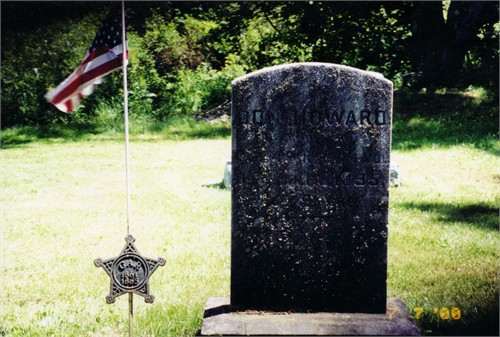
Don died Jan 28, 1895 and is buried in Rutland County, Vt.  above is a photo of his headstone.  Anna lived until Oct 5, 1929 (age 79).  She was said to have "senility" and died of "Atherosclerosis".


Regimental History
VERMONT
FOURTH REGIMENT.

THE Fourth Regiment Vermont Volunteer Infantry, was raised
chiefly in late August and early September, 1861,
simultaneously with the Fifth regiment. The Fourth, to the
extent of nearly nine of its ten companies, was raised on the
east side of the mountains, while the Fifth, in fully as great
a proportion, was being recruited on the westside.

Company A of the Fourth was fully raised in, and very near
to Bennington county. Windsor county furnished a larger number
than any other for the Fourth, being company C, most of E, a
considerable part of K, and a fraction of B--the larger part of
B being from Orange county; D was largely from Orleans county,
with a fraction from the northwesterly part of Windham county;
F was from Windham county, largely along the Connecticut River
in Brattleboro, Rockingham and between; G and H were chiefly
from Washington and Caledonia counties; I was largely from
Windham county, though partly from the north-easterly part of
the State,while K--except as above stated, and a small fraction
from Windham-was from Washington county and the north-westerly
part of Orange county.

Its original aggregate, as a regiment, was 1,048, of whom
it is believed less than forty deserted, some of whom returned.
The most numerous desertions were from companies C and K. The
smallest losses, "killed and died of wounds," (battle losses)
were in B, E, F, I and K, and of these, ten in B was the least.
Four companies--A, C, D and G--each lost over twice that
number. Twelve officers and one hundred fifty enlisted men
died in battle; one officer and two hundred seventy-nine
enlisted men died of disease and as prisoners, sixty of whom 
died in Confederate prisons.

In the battle of the Wilderness, Va., in May, 1864, seven
officers were killed and eleven wounded, one of whom died of
his wounds, and out of less than five hundred fifty enlisted
men in that battle, forty-one were killed outright. Two
hundred twenty-three were wounded, forty-three mortally, and
four were missing; so that, in this battle, the actual death
loss was eighty-four, the largest suffered by any Vermont
regiment in one battle, and a loss seldom equalled by any
infantry regiment in a single engagement during the war. Its
total losses by death were in excess of those of any other
infantry regiment from the State. The first Colonel, Edwin H.
Stoughton, was but 23 years of age. He was the youngest
officer to take a regiment from Vermont, and is believed to
have been the youngest from New England. His brother, Charles
B., (Second Col.) was made Colonel at 21.

The regiment was mustered in at Brattleboro, September 20,
1861, started for Washington next day, and in five days joined
the other Vermont troops then in Virginia, at Camp Advance, and
was soon followed by the Fifth and Sixth, which, with the
Second and Third who had "gone before," made up the "Old
Vermont Brigade," which remained unbroken, save by casualties,
and was present at the surrender of Lee. Like other Vermont
organizations the Fourth was fortunate both in its officers and
its men. It was also extremely fortunate to form part of a
brigade, organized and commanded by that gallant and unexcelled
soldier, Gen. W. T. H. Brooks; to form a part of a division,
led by the brave and soldierly Wm. F. Smith--"Baldy"--and of a
corps--Old Sixth--which, under the command of Franklin, and
later, of the incomparable Sedgwick, became the pride and idol
of the volunteer service. "Over all this waved the Greek
Cross" never humbled and never dishonored.

To have been esteemed worthy, for nearly four years of
war, to share the companionship in arms of our fellow regiments
from Vermont, and to have borne in their opinion a deserving 
part of the great work of the Old Brigade, ought to be, and is,
accepted as a sure passport that the Fourth regiment was all it
need to have been, or claims to be. Her history is everywhere
a part of the history of a brigade famed throughout our Nation,
and whose losses in battle, killed and mortally wounded, exceed
those of any other brigade in the Union armies, east or 
west.

ENGAGEMENTS.

Lee's Mills, Va., April 16, 1862.
Williamsburg, Va., May 5, 1862.
Golding's Farm, Va., June 26, 1862.
Savage's Station, Va., June 29, 1862.
White Oak Swamp, Va., June 30, 1862.
Crampton's Gap, Md., Sept. 14, 1862.
Antietam, Md., Sept. 17, 1862.
Fredericksburg, Va., Dec. 13, 1862.
Marye's Heights, Va., May 3, 1863.
Salem Heights, Va., May 4, 1863.
Fredericksburg, Va., June 5, 1863.
Gettysburg, Pa., July 3, 1863.
Funkstown, Md., July 10, 1863.

Rappahannock Station, Va., Nov. 7, 1863.
Wilderness, Va., May 5 to 10, 1864.
Spottsylvania, Va., May 10 to 18, 1864.
Cold Harbor, Va., June 1 to 12, 1864.
Petersburg, Va., June 18, 1864.
Weldon Railroad, Va., June 23, 1864.
Charlestown, W. Va., August 21, 1864.
Opequan, Va., Sept. 13, 1864.
Winchester, Va., Sept. 19 1864.
Fisher's Hill, Va., Sept. 21 and 22, 1864.
Cedar Creek, Va., Oct. 19, 1864.
Petersburg, Va., March 25 and 27, 1865.
Petersburg, Va., April 2, 1865.


Battles Fought
Fought on 12 Apr 1862.
Fought on 16 Apr 1862 at Lee's Mills, VA.
Fought on 8 Jun 1862.
Fought on 27 Jun 1862.
Fought on 29 Jun 1862 at Savage's Station, VA.
Fought on 30 Jun 1862 at White Oak Swamp, VA.
Fought on 1 Jul 1862.
Fought on 2 Jul 1862.
Fought on 7 Jul 1862.
Fought on 8 Jul 1862.
Fought on 10 Jul 1862.
Fought on 23 Aug 1862.
Fought on 3 Sep 1862.
Fought on 4 Sep 1862.
Fought on 14 Sep 1862 at Crampton's Gap, MD.
Fought on 14 Sep 1862.
Fought on 17 Sep 1862 at Antietam, MD.
Fought on 13 Dec 1862 at Fredericksburg, VA.
Fought on 3 May 1863 at Marye's Heights, VA.
Fought on 4 May 1863 at Salem Heights, VA.
Fought on 5 May 1863.
Fought on 28 Jun 1863.
Fought on 2 Jul 1863 at Gettysburg, PA.
Fought on 10 Jul 1863 at Funkstown, MD.
Fought on 24 Jul 1863.
Fought on 3 Sep 1863.
Fought on 6 Oct 1863.
Fought on 11 Oct 1863.
Fought on 14 Oct 1863.
Fought on 15 Oct 1863.
Fought on 18 Oct 1863.
Fought on 2 Nov 1863.
Fought on 3 Nov 1863.
Fought on 1 Dec 1863.
Fought on 5 May 1864 at Wilderness, VA.
Fought on 6 May 1864 at Wilderness, VA.
Fought on 9 May 1864 at Wilderness, VA.
Fought on 10 May 1864 at Spotsylvania Court House, VA.
Fought on 11 May 1864 at Spotsylvania Court House, VA.
Fought on 12 May 1864 at Spotsylvania Court House, VA.
Fought on 30 May 1864.
Fought on 3 Jun 1864 at Cold Harbor, VA.
Fought on 5 Jun 1864 at Cold Harbor, VA.
Fought on 6 Jun 1864 at Cold Harbor, VA.
Fought on 8 Jun 1864 at Cold Harbor, VA.
Fought on 9 Jun 1864 at Cold Harbor, VA.
Fought on 12 Jun 1864.
Fought on 14 Jun 1864.
Fought on 20 Jun 1864 at Petersburg, VA.
Fought on 21 Jun 1864.
Fought on 22 Jun 1864 at Petersburg, VA.
Fought on 23 Jun 1864 at Weldon Railroad, VA.
Fought on 9 Jul 1864 at Monocacy, MD.
Fought on 19 Jul 1864.
Fought on 21 Aug 1864 at Charles Town, WV.
Fought on 24 Aug 1864.
Fought on 13 Sep 1864 at Opequan, VA.
Fought on 19 Sep 1864 at Winchester, VA.
Fought on 29 Sep 1864.
Fought on 19 Oct 1864 at Cedar Creek, VA.
Fought on 25 Mar 1865 at Petersburg, VA.
Fought on 27 Mar 1865 at Petersburg, VA.
Fought on 2 Apr 1865 at Petersburg, VA.


BY LIEUTENANT-COLONEL STEPHEN M. PINGREE.